
An Engineer’s Guide to the Pianos of Campus, Part 1
- Oct 30, 2025
- 5 min read
Silhouette Magazine: Virginia Tech’s go-to for all things creative expression. Send in your submission for critique, wait a little bit, and get published! It’s a beautiful, well-executed mission, but the magazine can only feature you if your forms of creative expression fall into the categories of poetry, prose, art, or photography. Fundamentally, that comes from the limitations of the printed medium, but the Blog has no such limitations: it’s the lawless wild west of Silhouette. So, let’s spice things up around here!
I’m Jared, a Mechanical-Nuclear Engineer, choir singer, apprentice piano tuner-technician, and one of Silhouette’s new hires for the Blog. In this series, we will explore together the strange place where the worlds of music and engineering intersect: pianos! I will take you through the various buildings of Virginia Tech, locating these instruments in the most obvious of places, in the halls you’d least expect, and diving straight into the technical nitty-gritty, which I hope will give you an appreciation of the mechanical nuance behind musicality.
*****
If you ask someone on campus where you can find a piano, Henderson Hall will most certainly be their answer, making it the perfect place to begin this story. Home to the School of Performing Arts and the School of Visual Arts, this 180-year-old building packs enough sound-isolated practice rooms that you could cry in a new, interesting space every hour for a day leading up to your finals (and still have somewhere to curl up in a ball afterwards!). It’s perfect for musicians and engineers! It is also, of course, home to many pianos, and it is here that we are first introduced to the humble Boston Upright, commonplace on Virginia Tech's campus.
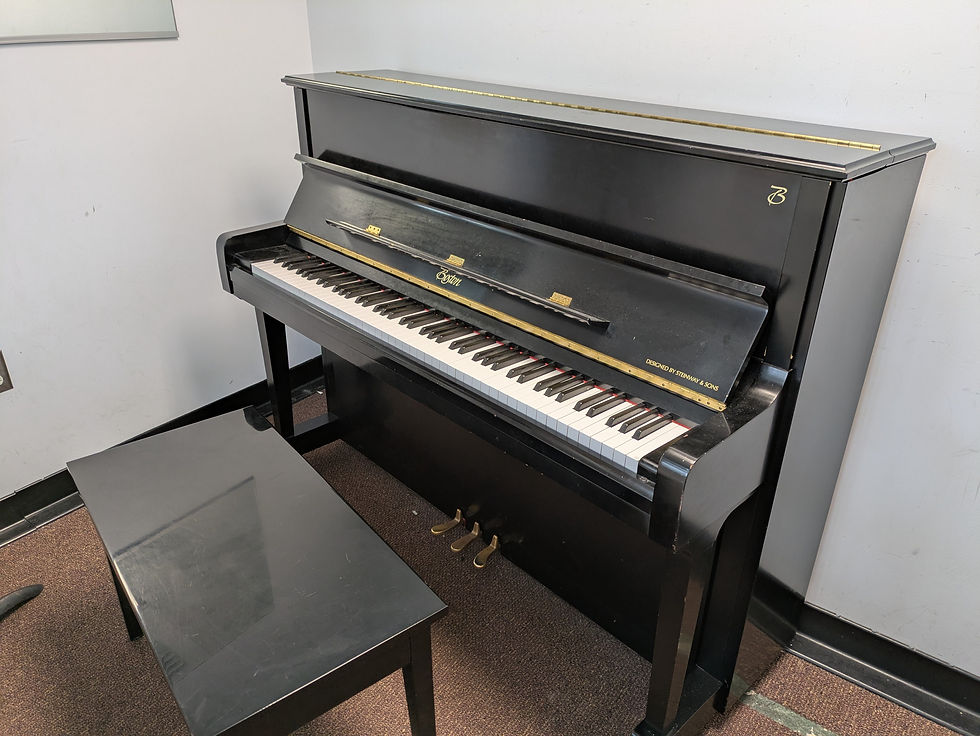
A Boston Steinway on Virginia Tech's campus, taken by Jared Jessup
Designed by the legendary American piano maker Steinway & Sons and manufactured by the Japanese-based Kawaii, the Boston is marketed at being the best bang for your buck (with emphasis on the bang) piano in its price range, especially when it comes to those who have practice rooms to fill and standards which, on principle, shall not be lowered. And oh, does it deliver on this: the action – consisting of the mechanisms behind the keypress – is one of the smoothest and most consistent that you will encounter, and the sound this piano produces is so pure that at first, I questioned if it was somehow a synthesizer. It is, in these regards, an exceptional piano, but admittedly, the Bostons within Henderson are not without their flaws.
Going back to the sound – many of the pianos have developed a “harshness” in their tone, which is quite often unpleasant to listen to. I’ll admit that this is a rather difficult idea to convey over text, so allow me to provide you with this example: a pure C played by a professional violinist, with their bow gliding across the strings using a precise and perfectly consistent force and pace, will produce a sound that is pleasant to the ear. It is a “softer” sound of impeccable quality and unmatched purity, free of noise and full of life and expression. A fourth-grader handed the same violin and the same bow could play the same
pitch, but we both know they will have more success in selling earplugs than in selling concert tickets. The tone may be technically correct, but the quality of the tone is ultimately much more important.
The sound produced by a piano, similar to that of the aforementioned violin, originates in the vibrations of the massive strings held in tension within its wood and cast-iron body, which are then amplified by the large spruce “soundboard” housed within. The vibrations themselves are produced by the hammers striking the strings, making the interface between the two components immeasurably important to the overall sound of the instrument. Knowing this, if you peer under the lid of one of Henderson’s Bostons, it quickly becomes apparent why its sound embodies such an unpleasant tone:

Piano hammers, taken by Jared Jessup
Just as a stream of water will carve its way through a mountain of stone given enough time, the hardened steel strings dig into the soft felt hammers with each strike, each press of the key, each sounding of a note, leaving an afterimage of themselves which only becomes more pronounced with each subsequent exposure. As these grooves get progressively deeper and the felt behind them denser, the strings’ vibrations gradually embody new
characteristics, expressed as the tone of the piano getting progressively “brighter”. These changed vibrations give extra emphasis to the ear-piercing higher frequencies known as “overtones” floating above the note played, which is ultimately the source of the perceived harshness of the tone. When the depth of the grooves has developed to this point, the only way to restore the original tone quality of the piano is to perform “voicing” on the hammers, where a technician uses specialty tools to remove the grooves, correct the density of the felt, and reshape the hammer into its original smooth and pointed form. This, however, is labor-intensive, requiring the utmost level of care, expertise, and experience, and is often forgone in your typical tuning due to the steep cost associated with it.
It may all seem negative, that this wear is the bane of all piano players, but I must admit, seeing such grooves in the hammers of a piano holds an almost poetic double-meaning to me. It does, of course, mean that the piano has not been maintained appropriately, that it has not been shown the love and care that it deserves. But it also means, almost contradictory, that these pianos have been loved immensely, enjoyed by all sorts of students seeking to express themselves musically. And these students, whether or not they’re aware of it, have left a physical imprint of their musicality within the inner workings of the instrument.
I can think of nothing that embodies this truer than the quote “to be loved is to be changed”. A piano that is meticulously maintained but never played, never appreciated for the music it can create, will have no grooves, no wear to be seen on its hammers. It simply sits there, unchanged, sentenced to a loveless eternity of being nothing more than a showpiece. It is only when a piano has been deeply appreciated by those around it that you will see such grooves in its hammers, such tangible physical evidence that the instrument has been played to its fullest. It takes passionate, unfettered love to create such change, and it’s quite clear that we Hokies love these pianos. The Bostons within Henderson Hall may not be the nicest pianos you’ll have access to as a student on campus – they may not have the nicest sound, or the cleanest keys, or be found in the most spacious of rooms – but you can still play them and appreciate them for what they are: universally enjoyed instruments of Virginia Tech students’ creative expression.


